
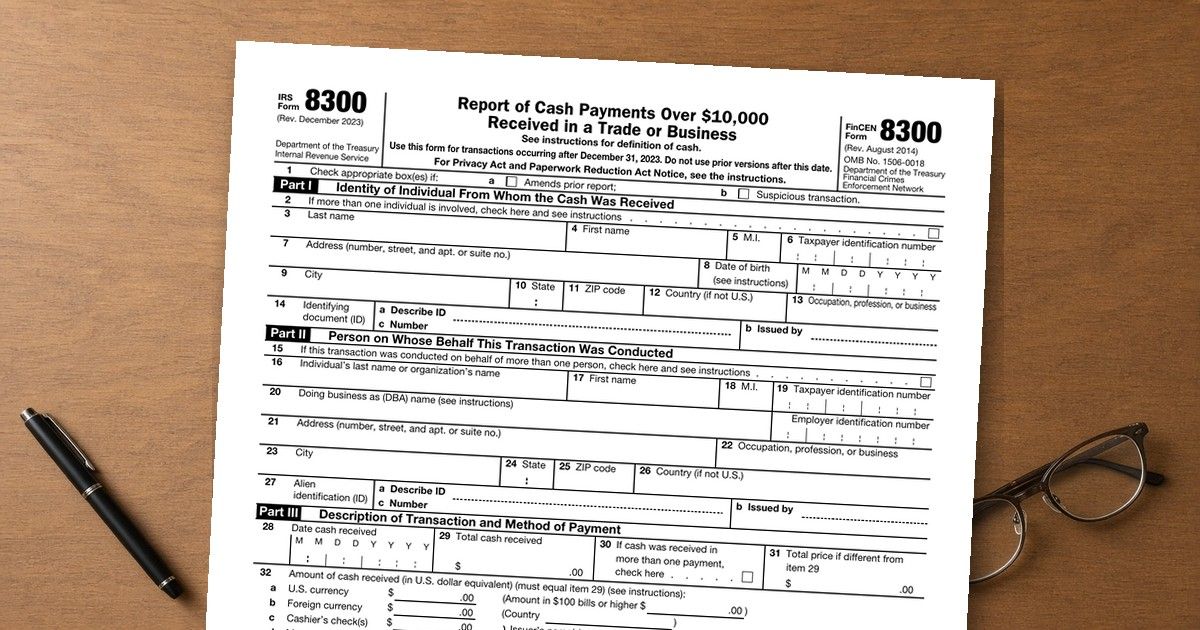
Large cash deals happen in this business. So do expensive mistakes when a store doesn’t report them.
MOIADA exists to educate, protect, and lobby for Missouri independent dealers. Form 8300 is federal—not a Missouri quirk—but it hits used-car lots hard. File it wrong or late and you’re looking at civil penalties. Help a customer structure around it, and you can face criminal exposure. Here’s what dealers need to know.
The Basic Rule
If you’re in a trade or business and you receive more than $10,000 in cash in a single transaction or in related transactions, you must file IRS/FinCEN Form 8300. That comes from IRC § 6050I and 31 U.S.C. § 5331. The IRS publishes dealership-specific Q&As because lots take big cash payments so often.
File within 15 days after the cash transaction (or after the payment that pushes related payments over $10,000). If day 15 is a weekend or holiday, file the next business day.
What Counts as “Cash”
Cash includes U.S. and foreign coin and currency, plus cashier’s checks, bank drafts, traveler’s checks, and money orders with a face amount of $10,000 or less when you receive them in a designated reporting transaction—and a retail auto sale is a classic one (retail sale of a consumer durable).
Cash does not include a personal check on the customer’s own account; a wire or ACH from a financial institution; or a cashier’s check, bank draft, traveler’s check, or money order with a face amount over $10,000 (the issuing bank reports those on a Currency Transaction Report).
Dealer examples from the IRS:
- Customer pays $9,000 cash plus a $4,000 cashier’s check → report. The cashier’s check is treated as cash in a retail vehicle sale, and the total exceeds $10,000.
- Customer pays with a single $12,000 cashier’s check → generally no Form 8300. Face amount over $10,000 is not treated as cash.
- Customer pays $9,000 cash and puts $6,000 on a credit or debit card, or wires part of the price → no Form 8300 when the cash (and cash equivalents) stay at or under $10,000. Cards, wires, and ACH aren’t cash.
Related Transactions and Installment Cash
Transactions with the same payer within a 24-hour period are related. They’re also related more than 24 hours apart if you know, or have reason to know, they’re a connected series. Weekly cash lease or loan payments on the same vehicle that total more than $10,000 in a 12-month period are related—file when the total crosses $10,000, then start a new count and file again each time another $10,000 accumulates.
Two cars sold to a husband and wife at once for $10,200 cash? One Form 8300. Five separate cash deals across a year, none over $10,000 alone? File only if you know or have reason to know they’re connected. Cancelled deals still count—if you took more than $10,000 cash and the deal later falls through, you still file.
What You Owe the Customer (and What You Must Keep)
For every required Form 8300, give each person named on the form a written statement by January 31 of the following year. Include your business name and address, a contact name and phone, the aggregate reportable cash, and a note that you furnished the information to the IRS. An invoice can work if it has all of that; multiple deals with the same customer in a year need one combined statement. Keep a copy of each Form 8300 for five years—an e-file confirmation email is not enough.
How to File in 2026
E-file through FinCEN’s BSA E-Filing System is free and gives you an acknowledgment. Effective January 1, 2024, if you must e-file other information returns (at least 10 returns of types other than Form 8300 in the year—W-2s, 1099s, and so on), you must e-file Forms 8300 too. Forms 8300 don’t count toward that threshold. Under it, paper filing to the IRS Detroit address in the instructions is still allowed. Mark late returns “LATE.” Paper-filing when you’re required to e-file counts as late.
Suspicious Activity and Structuring
You may voluntarily file Form 8300 for a suspicious transaction of $10,000 or less. Check the suspicious-transaction box and do not send the customer statement for a voluntary/suspicious filing—never tip them that you marked it suspicious. You can tell a customer the law requires reporting cash over $10,000. What you cannot do is help them break up payments to dodge the form. Structuring—and helping someone structure—can bring civil and criminal penalties.
Penalties (2026)
For information returns and payee statements due in calendar year 2026, the IRS lists these civil amounts per return or statement:
- Corrected within 30 days: $60
- 31 days late through August 1: $130
- After August 1 or not filed: $340
Intentional disregard of Form 8300 rules carries much higher civil exposure (historically the greater of a fixed amount or the cash received, with a per-return cap), and willful failures can be prosecuted as felonies. Those intentional-disregard dollars are inflation-adjusted—check the current IRS Form 8300 reference guide and IRC §§ 6721, 6722, and 7203 before quoting a figure in training materials.
Protect Your Store
Train the desk and F&I on what “cash” means for a retail vehicle sale. Build a checklist for TINs, ID verification, the 15-day clock, and the January 31 customer statement. When a payment pattern looks designed to stay under $10,000, document it and talk to your advisor—don’t help the customer redesign the deal.
MOIADA has looked out for Missouri independent dealers since 1969. Compliance education is part of that job. Join MOIADA for association support and NIADA membership, or start with the Missouri dealer pre-license seminar if you’re still getting licensed. We’re here for dealers—to educate, protect, and lobby for your interest.
Sources
- Form 8300 and reporting cash payments of over $10,000 (IRS)
- Motor vehicle dealership Form 8300 Q&As (IRS)
- IRS Form 8300 reference guide
- Instructions for Form 8300 (Rev. 12/2023)
- Information return penalties (IRS) — amounts for returns due in 2026
- Publication 1544, Reporting Cash Payments of Over $10,000